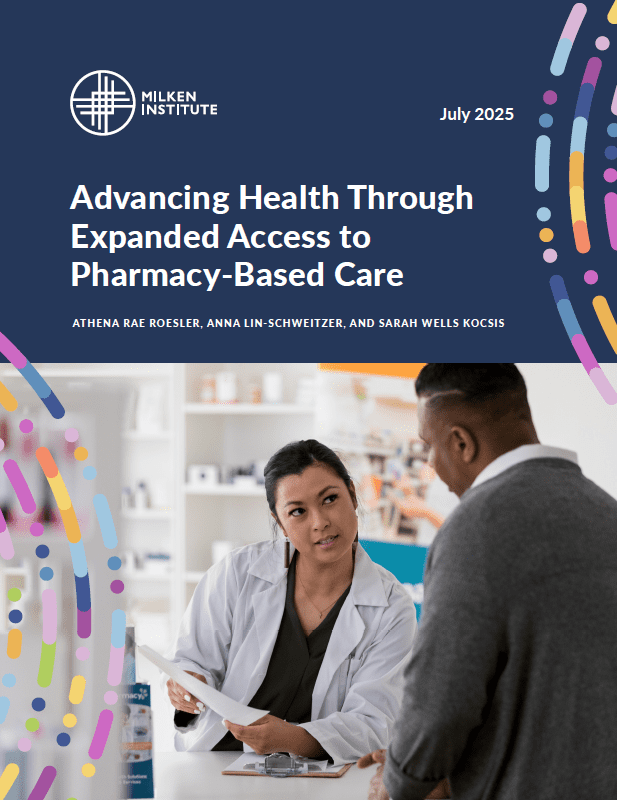
The Milken Institute set out to solve a structural blind spot in US health care: pharmacies are among the most accessible points of care in the country, yet the health system has no consistent, scalable way to pay for or integrate the clinical services pharmacists are trained to provide. Advancing Health Through Expanded Access to Pharmacy-Based Care was built to close that gap — not just by describing the problem, but by giving policymakers, health systems, and payers a concrete, usable path to fix it.
The report identifies 13 priority pharmacy-based services, spanning chronic disease prevention and management, mental and behavioral health, and reproductive and sexual health, chosen because they build on workflows pharmacists already have and address urgent public health needs. Because pharmacist's scope-of-practice law varies enormously state by state, the team knew a static report alone wouldn't move the needle. So, a second, interactive component was built alongside the written research: the Interactive Pharmacist Prescriptive Authority Explorer Map, a tool that lets any user select a specific service and instantly see which states authorize it and under what conditions.
This map reframes pharmacy-based care as a serious, evidence-backed lever for expanding access rather than a stopgap, and makes the fragmented, hard-to-track patchwork of state authority visible and navigable in a single interactive tool so advocates and decision-makers could see exactly where the opportunities for expansion exist.
The project combined rigorous policy research with an interactive data tool designed to make that research usable in the real world. Before this project, no single resource compiled a comprehensive view of the health care services pharmacies are equipped to provide. Bringing that list together in one place gives health plans and other providers a shared reference point for coordinating care and offers a foundation that can be used to educate consumers on the full range of services available to them at the pharmacy.
Research: The Milken Institute Health team analyzed the current reimbursement, infrastructure, and policy barriers preventing pharmacy-based care from scaling nationally. Rather than treating pharmacy services as a singular entity, the team narrowed the universe of possible interventions down to 13 priority services, selected specifically because they align with pharmacists' existing scope of practice and address the health system's most pressing gaps: chronic disease, mental and behavioral health, and reproductive and sexual health. The research drew its strength from direct engagement with a wide range of experts, including pharmacy leaders and health plan representatives who came together in a roundtable discussion, a level of cross sector collaboration that is uncommon and gave the report’s recommendations added credibility and real world grounding.
Developing an interactive tool: A major challenge was translating fifty states' worth of fragmented, constantly shifting authority landscapes into a tool that can be used to inform decisions. The team built the Pharmacist Prescriptive Authority Explorer Map, an interactive tool that compiles prescriptive authority data across all states for each of the priority services. Users select a service from a drop-down menu, and the map updates to show, state by state, what pharmacists are and are not currently authorized to do — with each state clickable through to its underlying legal source. This required not only compiling and verifying the authority landscape, but designing an interaction model versatile enough for advocates, journalists, health system leaders, and policymakers alike to use.
Unique features: Unlike a static chart, the interactive map turns a genuinely fragmented regulatory landscape into a cohesive visual tool. This is then paired directly with the report's policy recommendations, so the interactive experience isn't just visually appealing — it coalesces evidence that makes the case for increased access to care needs through pharmacies.
Other challenges: Another hurdle was confirming accuracy and currency: pharmacist authority law changes frequently and inconsistently across jurisdictions, so the team had conduct a rigorous verification process while being transparent about the map's innate point-in-time limitations (explicitly noting it reflects the landscape as of July 2025 and directing users to consult counsel for legal decisions). Balancing that intensive research with an easy-to-use interface required close collaboration and the utmost diligence.
Advancing Health Through Expanded Access to Pharmacy-Based Care succeeded in turning a diffuse, hard-to-communicate policy problem into a concrete, actionable resource — and the interactive map made that resource usable rather than theoretical.
The report was covered by four outlets, including Drug Topics and Drug Store News, and publicized across all Milken Institute social media channels, where it was then featured in a post by the CDC Foundation on LinkedIn.
Against the objective of making the state-by-state authority patchwork navigable, highly relevant organizations have engaged this report along with the Prescriptive Authority Explorer Map, including the Centers for Disease Control and Prevention, Hy-Vee, Howard University, and the Social Determinants of Health Institute. This demonstrates real demand for this type of tool, so advocates and decision-makers no longer need to comb through fifty separate state statutes to understand where expansion opportunities exist.
This report provides data visualizations, evidence, and suggestions for policymakers to expand access to healthcare through pharmacies. The Office of Disease Prevention and Health Promotion highlighted this research under their Food is Medicine (FIM) campaign, noting that pharmacy-driven actions can support healthcare plans, which often include FIM efforts.