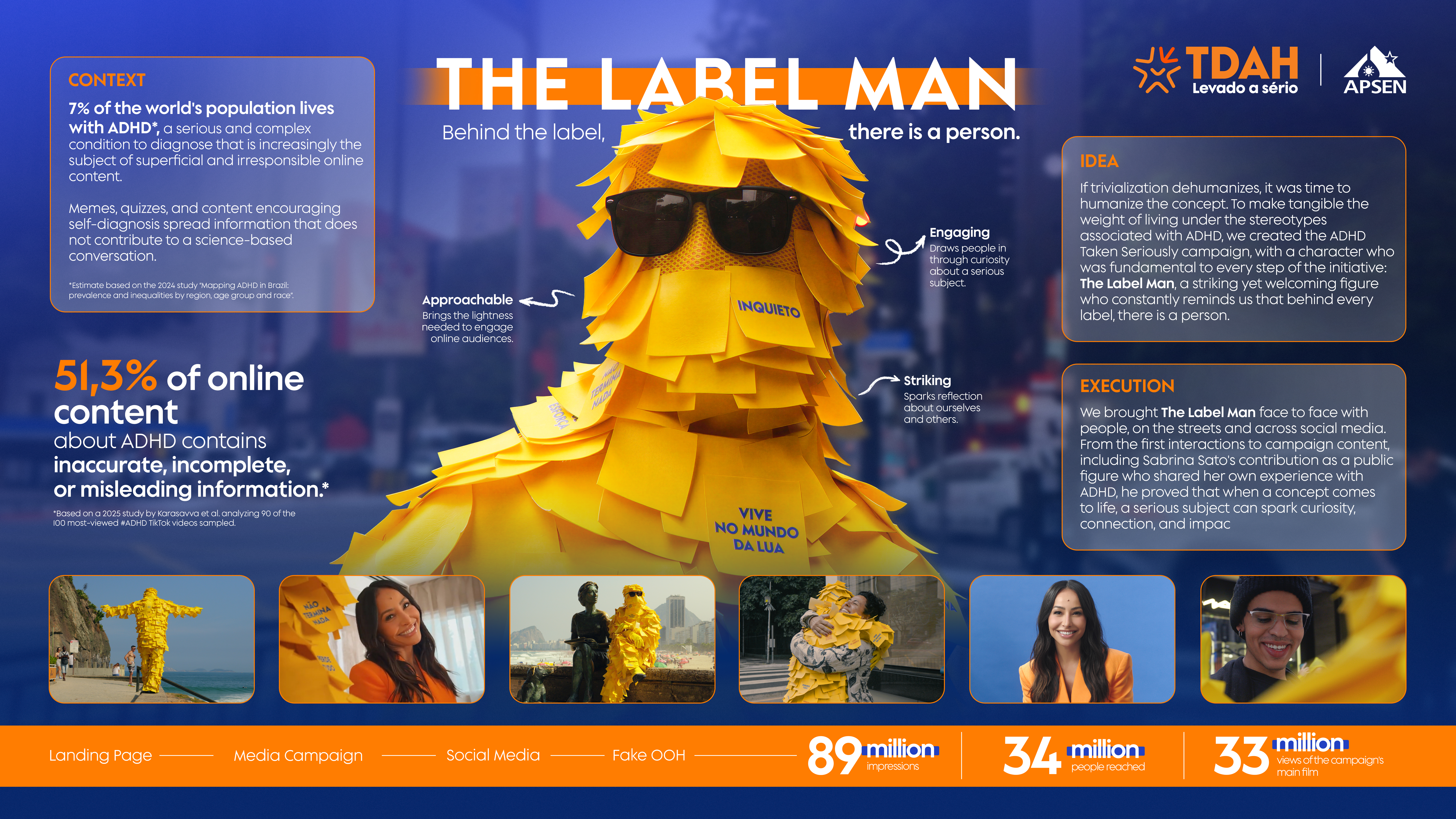
The campaign was created in response to a new challenge: the problem was no longer a lack of online information about ADHD, but an excess of superficial and often inaccurate content. In response to this phenomenon, we developed an initiative aimed at combating superficial content about ADHD and provide the general public with scientifically supported information on the subject. To improve the quality of conversations about ADHD on social media, countering the trivialization of the condition and expanding public access to reliable, accessible, evidence-based content.
At the same time, Apsen sought to establish an ongoing awareness platform, strengthen its institutional positioning in mental health, and encourage responsible diagnosis and medical follow-up. The indicators were defined to assess the campaign’s ability to achieve its main objective: transforming a one-off awareness initiative into an ongoing ADHD education platform, expanding access to reliable information and strengthening Apsen’s positioning as a reference on the subject.
They focused on media reach and efficiency, engagement with and consumption of educational content, qualified traffic to campaign assets, and the development of a proprietary health education platform. Throughout the project, these indicators were monitored to assess both channel performance and the campaign’s ability to generate interest and establish a long-term communications asset for the brand.
We started with one insight: people were already talking about ADHD. The challenge was helping them understand it correctly. Rather than competing for attention with the culture of trivialization, the campaign used it as an entry point to science-based content. While the language of social media brought audiences closer, the platform allowed them to deepen their understanding.
Each initiative played a specific role. Creators expanded reach, experts brought credibility, Sabrina Sato gave visibility to the subject, the videocast enabled deeper conversations, and the platform brought all the content together in one place. One of the campaign’s main findings was that educational content, when translated into accessible, creative language suited to the dynamics of digital platforms, can generate high levels of engagement without compromising scientific rigor.
Another major learning was the value of integrating different voices. The combination of experts, influencers, and a national ambassador expanded the campaign’s reach and strengthened its credibility with the public. Continuous monitoring also showed that more in-depth content generated qualified interest and increased interaction time with the platform, demonstrating demand for reliable information about ADHD.
Finally, the campaign showed that an awareness initiative can evolve into an ongoing communications asset. By integrating creativity, science, media, and content within a single ecosystem, Apsen established a proprietary health education platform and strengthened its role as a leading voice in the informed conversation around ADHD.
The execution was structured as an integrated communications ecosystem, with each initiative playing a specific role in the audience journey. The film and manifesto drew attention to the subject, creators and Sabrina Sato expanded reach and visibility, the videocast deepened the discussion, public relations extended the conversation into new spaces, and the platform brought all the content together in one place. The Label Man served as the connecting element across every stage, ensuring creative consistency and a cohesive message across different formats and channels.
The Label Man concept was designed to serve as the central pillar of the campaign and was applied consistently across all activations. The same visual metaphor was adapted across films, Fake OOH, social media, videocast, PR, and digital content, preserving the campaign’s identity at every touchpoint. This consistency ensured immediate recognition of the concept and strengthened the audience experience throughout the entire campaign.
The main challenge was bringing The Label Man to life. Initially developed with the support of artificial intelligence, the character needed to become a physical, credible figure with personality, capable of preserving the full impact of the original creative idea while also generating attention, empathy, and reflection. The entire campaign communication depended on successfully bringing the character to life.
The campaign is still ongoing, so the final assessment of its objectives will take place once it has concluded. However, partial results indicate that the strategy is on track to meet the expected targets. The indicators already demonstrate high media efficiency, strong engagement, and broad dissemination of the campaign message, reinforcing its potential to establish the ADHD education platform and strengthen Apsen’s institutional positioning. The campaign is still ongoing, so it is not yet possible to present a consolidated ROI. A complete assessment will be conducted once all communications and business results can be analyzed together. Even so, partial indicators already demonstrate efficient use of the investment, with media performance above target and strong audience reach, reinforcing the effectiveness of the strategy.
The main KPIs monitored to date have performed above plan. The strategy has surpassed 89 million impressions, reached more than 34 million people, and generated 33 million views of the campaign’s main film. These results reinforce the efficiency of the strategy, with indicators being achieved and, in several cases, exceeded even before the campaign has concluded.