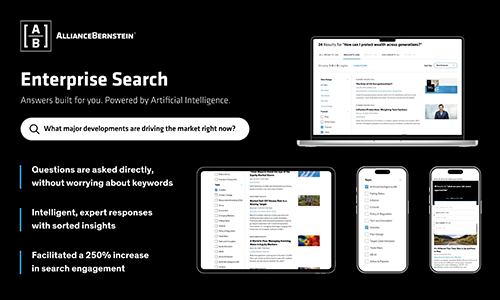
Enterprise Search was developed to solve a growing challenge within AllianceBernstein: valuable knowledge, research and client-facing content existed across multiple systems, making it increasingly difficult for employees and advisors to quickly locate the information they needed.
The objective was to create a unified, AI-powered search experience that would simplify access to institutional knowledge while improving discoverability, efficiency and collaboration across the organization. Rather than requiring users to navigate multiple repositories or rely on exact keyword searches, Enterprise Search was designed to allow users to ask direct questions in natural language and receive relevant, contextual answers drawn from trusted internal sources.
As one of the earliest large language model-powered enterprise search implementations within a major financial services firm, the project sought to demonstrate how generative AI could be applied in a practical, scalable way to improve everyday workflows. The goal was not simply to modernize search, but to fundamentally improve how people discover, access and apply information across the organization.
The vision behind Enterprise Search was to move beyond traditional enterprise search and create a more intuitive knowledge experience powered by conversational AI.
Historically, information was distributed across multiple repositories, platforms and content systems. While valuable content existed throughout the organization, users often needed to know where to look, how content was tagged or which keywords to use. This created friction, duplicated effort and limited the value of information already being produced.
To address this challenge, AB developed Enterprise Search as a centralized platform that integrates content from multiple internal sources into a single searchable ecosystem. The project combined large language model technology with structured metadata, intelligent indexing and dynamic filtering to create a more natural user experience.
Rather than forcing users to navigate complex repositories, Enterprise Search allows them to ask direct questions in everyday language. The platform interprets intent, surfaces relevant information and provides contextual responses drawn from trusted internal content. This conversational approach significantly reduces the time and effort required to locate information while making knowledge more accessible across business functions.
Execution required close collaboration among technology, digital, content and business teams. The project focused not only on AI capabilities, but also on the underlying content architecture needed to support accurate and useful results. Metadata standardization, content integration and governance processes were critical to creating a reliable search experience.
The result is a platform that functions as a centralized knowledge layer across the organization, improving discoverability, reducing complexity and helping users access information more efficiently than traditional search methods.
Enterprise Search transformed how information is discovered and accessed across AllianceBernstein by replacing fragmented search workflows with a centralized, AI-powered experience.
Users can now interact with institutional knowledge through direct questions rather than relying on exact keywords or navigating multiple repositories. This significantly improves usability while reducing the time required to locate relevant research, insights and client-facing materials.
The platform increased discoverability across existing content ecosystems, helping teams surface valuable information that might otherwise remain difficult to find. By connecting multiple content sources into a unified experience, Enterprise Search improved knowledge sharing, reduced friction across workflows and strengthened collaboration across business functions.
The initiative also demonstrated a practical enterprise application of generative AI within a highly regulated financial services environment. Rather than treating AI as a standalone experiment, AB integrated the technology into a core business workflow, creating measurable operational value while improving the overall user experience.
The result is a more connected, efficient and scalable approach to knowledge management that continues to strengthen how information is accessed and utilized across the organization.