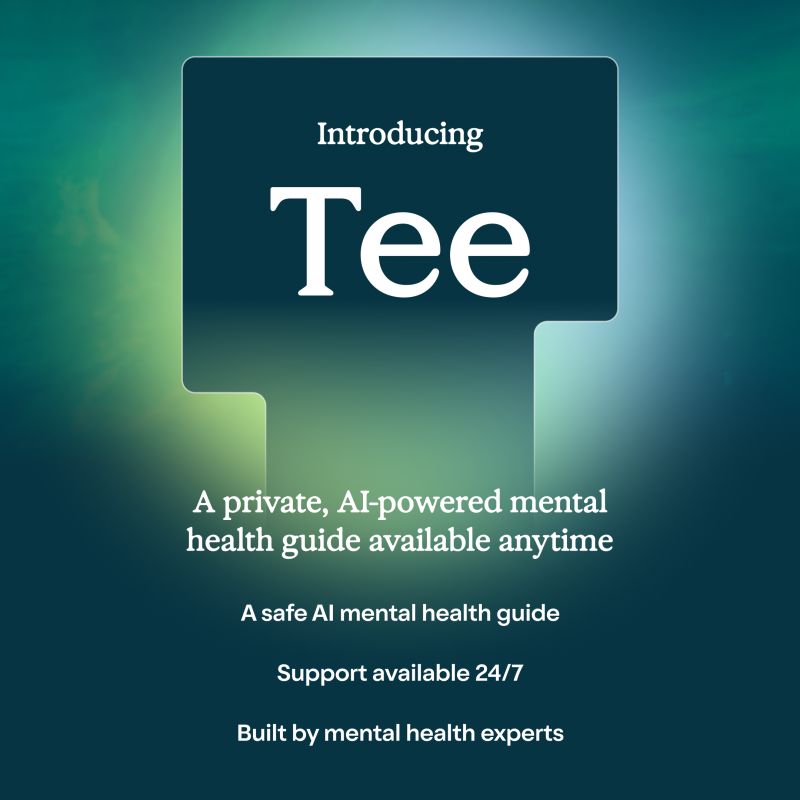
Millions of people are already turning to general-purpose large language models for mental health support, even though these tools were not designed for sensitive mental health conversations. The general AI bots can respond with unwarranted confidence, reinforce harmful thinking, or fail to recognize signs of crisis, potentially putting vulnerable users at greater risk.
As one of the nation’s largest behavioral health providers, Talkspace saw both an urgent need and a responsibility to offer a safer alternative. With Tee, we applied AI’s accessibility and immediacy within a framework built specifically for mental health, grounded in more than a decade of clinical expertise and designed with robust safeguards from the outset.
Our objective was to create an AI mental health companion to help adults reflect on their emotions, process difficult experiences, and practice healthier coping strategies in the moments when they need support. Just as importantly, Tee needed to recognize its limits, identify potential safety concerns, and guide people toward professional or emergency care when appropriate.
Because we recognized the importance of making mental health accessible to as many people as possible, we designed Tee as a standalone mental health guide. People don’t need to be Talkspace therapy clients to use Tee.
Tee is not intended to diagnose conditions or replace a therapist. Its purpose is to provide a responsible entry point to mental health support: meeting people where they are, helping them take a constructive next step, and connecting them to human care when they need more.
Tee was built as the first of its kind in the nation to provide a safer, clinically informed alternative to the general-purpose AI tools people are already using for mental health support. From the outset, Talkspace treated safety, privacy, and human oversight as core product requirements, not features to be added after launch.
Tee was developed using Talkspace’s clinical expertise and one of the world’s largest mental health datasets. All training data was anonymized and used with consent.
The model underwent rigorous training and beta testing against clear safety benchmarks and validated clinical scales. A central component of development was red-teaming: an integrated safety framework designed to systematically test and strengthen Tee’s clinical boundaries. Talkspace clinicians stress-tested the model across complex and high-risk mental health scenarios, while a human-calibrated automated scoring system evaluated its responses. These insights informed additional safety-focused training, creating a repeatable process for measuring, auditing, and improving how Tee responds in sensitive situations.
This approach differentiates Tee from general-purpose large language models. Tee is grounded in Talkspace’s clinical data and expertise, detects potential high-risk behavior in real time, and escalates users toward human support, and operates within HIPAA-aligned security and privacy standards. It is designed to understand both what it can do and when it must step back and bring in real-life clinicians when a situation escalates.
The challenge was not simply building the technology. We also needed to earn public trust in a category marked by understandable skepticism and fear that AI will replace therapists. Our marketing campaign therefore positioned Tee clearly as a human-supervised mental health guide, never as “AI therapy” or a substitute for licensed care.
Every element of the launch reinforced those boundaries. We created a demonstration video and educational landing page to show how Tee works, what it is intended for, and when professional care is more appropriate. We then brought that message to audiences through earned media, syndicated content, paid social media, and influencer partnerships.
The result was a campaign that did more than introduce a new product. It established a responsible model for bringing AI into mental health: clinically grounded, transparent about its limits, and designed to connect people with human care when they need it.
The results validated both sides of our objective: Tee met a real need for accessible mental health support while operating within carefully designed clinical boundaries.
We saw 1,500 completed sessions during beta, with nearly one quarter returning for at least a second session. Many arrived in significant distress, reporting an average initial well-being score of just 37 out of 100. Their most common concerns included relationship difficulties, depression, low self-esteem, trauma, and grief.
Tee also delivered strong clinical and safety performance. It outperformed commercially available models across four internal clinical-quality benchmarks. Safety testing included 10,000 expert-written examples and an automated scoring system calibrated against more than 500 ratings from mental health professionals. In a clinical audit of 278 unflagged sessions, reviewers found zero missed acute emergencies, and no beta sessions required emergency escalation.
Just as importantly, users said Tee provided the experience we intended. They praised its thought-provoking questions, ability to remember previous conversations, judgment-free environment, and round-the-clock availability. One user described Tee as “a resource I can access 24/7” when their therapist was unavailable, reinforcing its role as a complement to professional care, not a replacement.
Since its June 9 launch, Tee has earned 18 media placements with a combined audience of more than 78 million unique monthly visitors. Coverage has been overwhelmingly positive, helping build public understanding of a safer, clinically grounded approach to AI-powered mental health support.