Between October and November 2025, SNAP benefits were torn away from millions of Americans in need. Since Bar-S is a value brand, we knew our consumers could be among those hardest hit.
Our goal in that moment was simple: move quickly to help as many people avoid hunger in the most direct way possible.
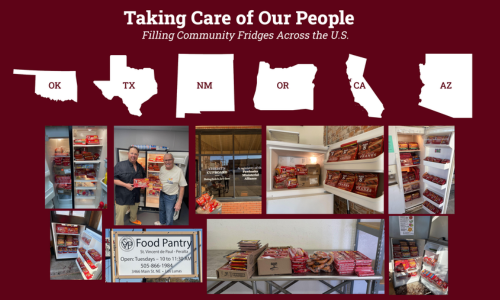
Instead of contemplating CSR program names, branded partnerships or how much we could convince upper management to donate, we used that time and effort to hit the ground running, personally filling community fridges with as many Bar-S products as possible in the brand's hometown communities in Phoenix. To inform those in need of the fridge locations and encourage others to join us in filling them, we made a simple TikTok and IG reel. What we didn't expect was a viral outcry of people thanking us for helping, updating us on fridge stock and telling us where we should stock next.
Seeing that made the crisis all the more tangible and motivated us to mobilize Bar-S teams nationwide to act quickly and do the same in their community fridges.
We hoped to transform a single act into a chain of goodness, extending practical help, strengthening community connection, and demonstrating that brand values can translate into real-world action when it matters most.
We brought this project to life by prioritizing speed, authenticity, and real community impact over traditional campaign mechanics. Our plan of action was deliberately simple: move quickly, provide tangible help, and communicate clearly. Rather than a complex production or paid media strategy, we focused on direct action that reflected the core values of Bar-S.
Execution began with a small team deployed to Phoenix. Using local research, community resources, and publicly accessible information, we identified three community fridges in areas where food accessibility could be particularly meaningful. The team physically stocked each fridge with Bar-S products, ensuring the effort began with real-world contribution. This boots-on-the-ground approach allowed us to create immediate value while staying closely connected to the communities we hoped to support.
Content creation was intentionally simple. Virality was never the objective; clarity and sincerity were. The video was filmed in a straightforward, POV style, designed to inform rather than entertain. We avoided trending sounds, polished brand tropes, or overly produced elements that might dilute the message. The edit remained simple and human, reinforcing a single takeaway: free food was available, no questions asked. The video was shared organically across Facebook, TikTok, and Instagram to maximize accessibility without introducing barriers or delays associated with paid amplification.
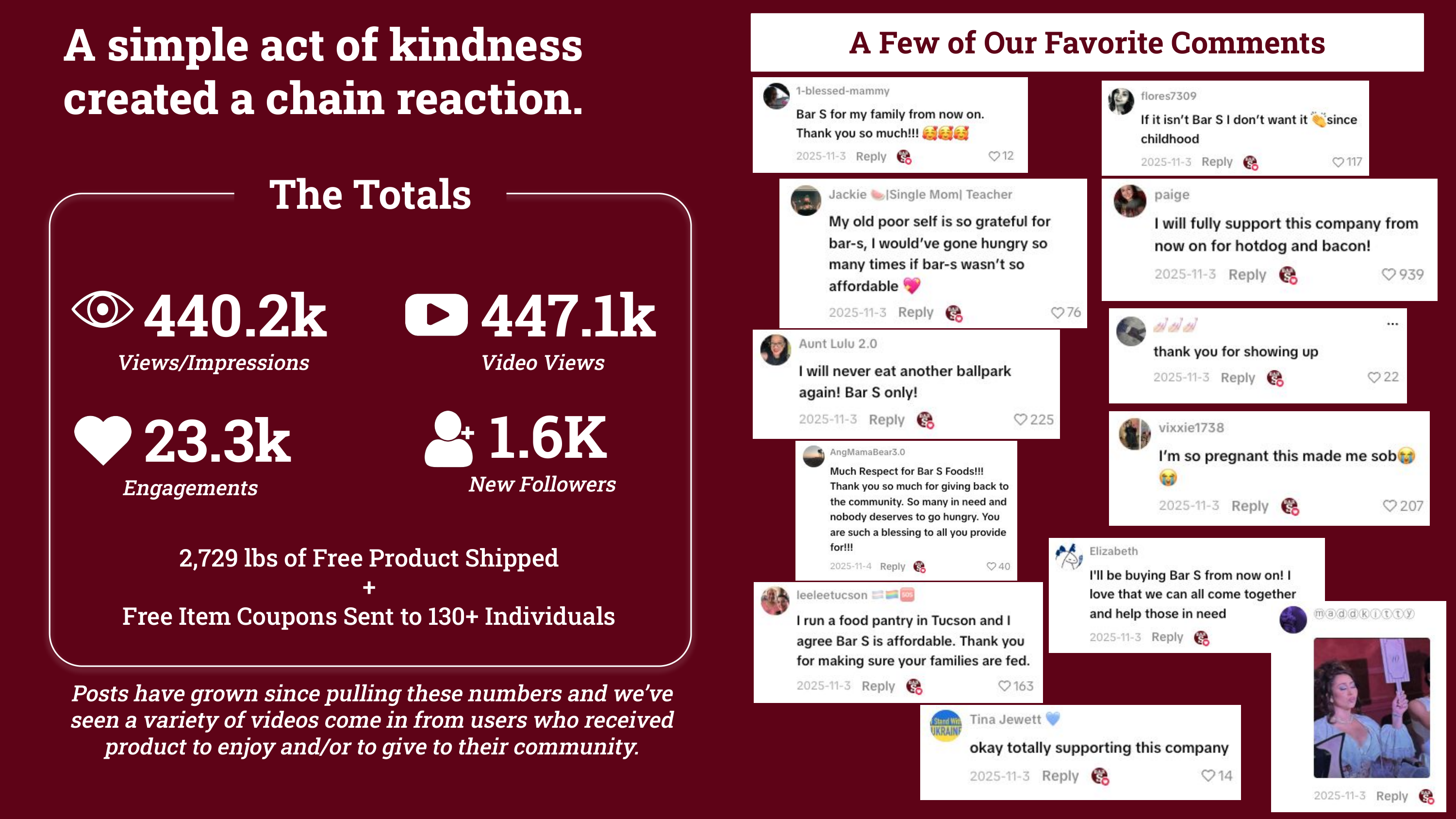
A major challenge emerged after launch: community management at scale. The posts generated over 1,000 comments across platforms, a volume far beyond typical organic engagement for the brand. Importantly, many comments came from individuals seeking help, asking questions, or sharing personal stories. This shifted the nature of the work from campaign management to active support. We recognized that ignoring or delaying responses would undermine the very purpose of the initiative. To address this, we utilized rapid-response efforts, replying to hundreds of users as quickly as possible and inviting them into DMs for more personalized assistance.
The DM strategy became a critical feature of the project’s impact. Conversations revealed a range of needs, from temporary hardship to immediate food insecurity. Depending on individual situations, we provided free item coupons or arranged to send product boxes directly to households. This transformed the project from a broad awareness effort into individualized assistance, extending its value well beyond the initial fridge activations.
To scale the initiative, the team activated internal networks. An email was distributed to the national sales team, calling for voluntary, localized participation. Team members were encouraged to identify community fridges in their own regions and contribute directly. Participants were reimbursed for product used to stock their selected fridges, decentralizing the campaign and allowing it to grow organically through employee involvement. What began as a single-market activation evolved into a distributed chain of community support.
The unusual approach to this work lied in going against standard marketing best practices. Instead of designing for reach, impressions, or trends, we designed for usefulness. Instead of optimizing for performance metrics, we optimized for responsiveness and accessibility. The project demonstrated that a brand's meaningful action alone can be the most powerful form of communication.
Our results weren't rooted in views and engagements, they were rooted in the question: "did we help our people when they needed us most?" The answer, in short, was overwhelmingly yes.
Across Facebook, TikTok, and Instagram, our videos earned over 447k views and 23.3k engagements (all organic). Over 1k comments came in alongside hundreds of DMs asking for our assistance and even providing resources for us to consider. Consumers were pouring their heart out in a time of food insecurity and we were there to help.
We sent out over 130 sets of free-item coupons, 2,729 lbs of free product, and deployed our national team members to assist in searching for and filling their local community fridges, which resulted in fridges filled in Phoenix, AZ, Los Angeles, CA, Pawhuska, OK, Los Lunas, NM, Lubbock, TX, Garland, TX, McMinnville, OR, and Santa Ana, CA. Of the boxes of food sent out, we had several small-scale food pantries who reached out due to low supplies during the government shutdown and SNAP delays. Users created videos thanking us for seeing a need and filling it.
Were we as viral as major campaigns with media spend behind them? No. Did we ensure our consumers were taken care of and relieved during a time of stress and uncertainty, and did we inspire others across the U.S. to do the same? You bet we did.