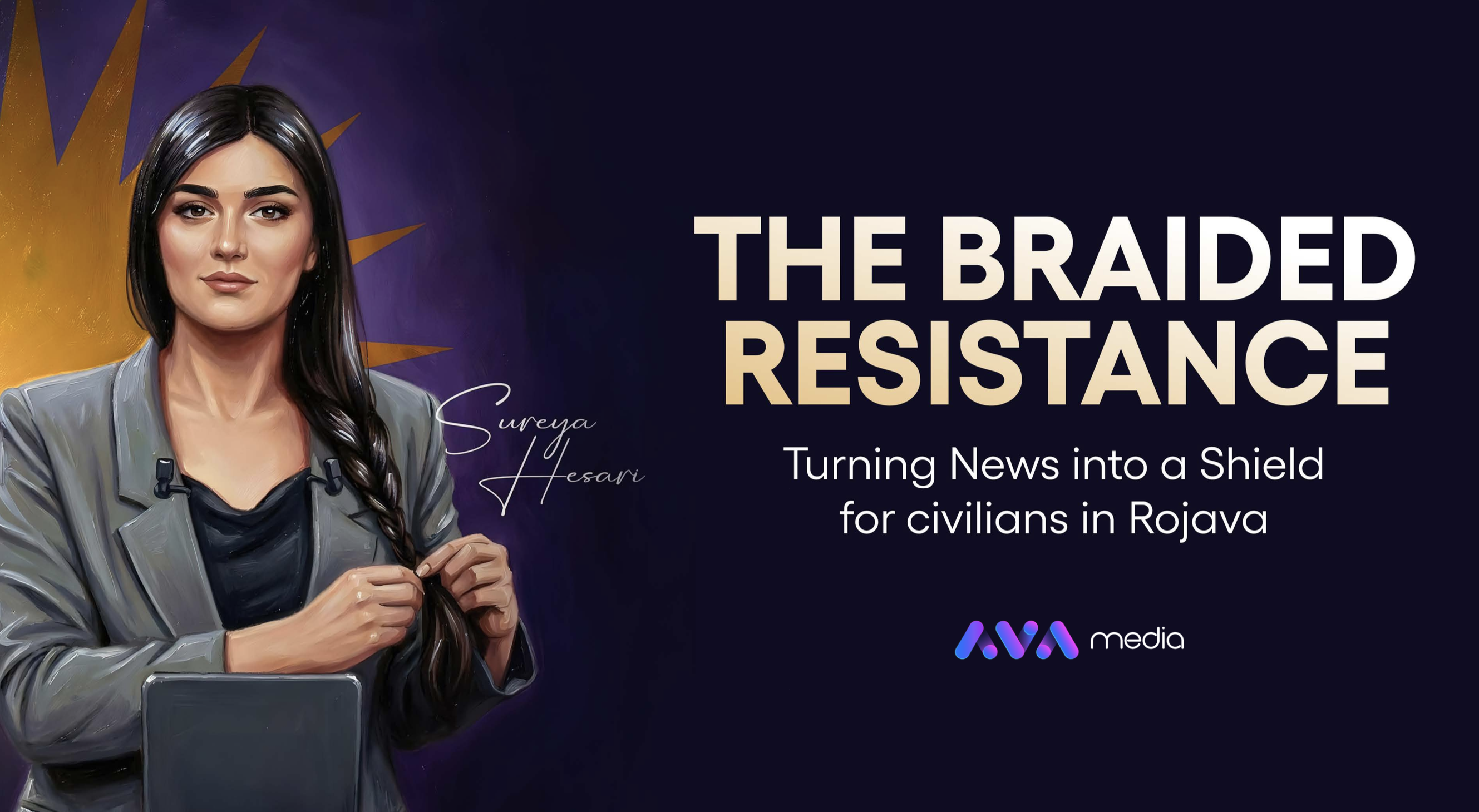
When conflict escalated across Rojava in January 2025, thousands of civilians—particularly Kurdish communities—were displaced, targeted, and cut off from clear information. In the face of ethnic cleansing, military confrontation, and the rapid collapse of normal life, our objective was immediate and urgent: transform journalism into protection.
AVA Media launched a continuous crisis coverage model to document events in real time, amplify civilian voices, and ensure that what was happening in Rojava could not be ignored. We aimed to break through misinformation and silence by reporting directly from affected areas, bringing forward the testimonies of displaced families, medical workers, and community members. Our objectives were therefore threefold:
Elevate local voices to international visibility and drive global awareness.
Apply sustained media pressure to encourage humanitarian access and open corridors for aid.
Maintain uninterrupted, frontline reporting despite threats, digital attacks, and security risks.
Beyond broadcasting headlines, we sought to convert visibility into measurable humanitarian response. By committing to daily coverage and on-the-ground reporting, we aimed to demonstrate that media can function not only as a witness to crisis—but as an active force for civilian protection and accountability.
Within hours, we transformed our newsroom into a crisis-response broadcasting hub, launching 6–7 hours of daily continuous live coverage. What began as emergency reporting quickly evolved into a 30-day, 200-hour marathon of frontline journalism.
The coverage was led by senior anchor Sureya Hessari — herself a daughter of Rojava whose family had been displaced five times. For her, this was not a distant conflict. It was personal. That authenticity shaped the tone and urgency of the coverage. Our strategy centered on three pillars: nonstop visibility, direct civic access, and field reporting.
First, we sustained uninterrupted broadcasting to prevent the crisis from fading from public attention. Second, we opened phone lines and digital channels for civilians trapped in conflict zones, interviewed doctors working in overwhelmed hospitals, and brought displaced families live onto the broadcast. Third, we directly questioned political leaders and decision-makers in real time, transforming the program into a public accountability platform rather than a passive news desk.
Recognizing that studio coverage was not enough, Sureya made the decision to enter Rojava, Syria, with an AVA Media crew. She reported from Derk, Qamishlo, and Hasaka — documenting shelters, damaged neighborhoods, and hospitals under pressure. Field reporting added credibility, urgency, and undeniable evidence at a time when misinformation was spreading rapidly online.
The challenges were severe. As a Kurdish female journalist reporting from the frontlines, Sureya became a target of extremist groups. She received verified death threats, social media “execution warnings,” and direct ultimatums to leave or face death. Security risks were constant. Digital attacks and coordinated intimidation campaigns attempted to silence coverage. Sureya decided to remain in the frontlines and continue delivering the voice of her people.
In a region where women are often silenced, her presence alone was defiance.
When extremist groups attempted to humiliate Kurdish women by cutting their hair as an act of intimidation, Sureya responded live on air. She braided her hair during the broadcast and declared: “If you cut one, we will braid a thousand more.” The braided “Kazi” became an immediate symbol of defiance and unity, spreading rapidly across digital platforms and transforming the narrative from fear to resilience.
What made this project unique was the fusion of journalism, symbolism, and civic mobilization. The newsroom functioned as an operational center connecting civilians, authorities, and global audiences in real time. Coverage did not merely document events — it actively pressured for humanitarian corridors, amplified marginalized voices, and created a cultural symbol that strengthened community morale.
This was not crisis reporting from a distance. It was frontline journalism that refused to look away — and refused to be silenced.
Our objective was to transform visibility into protection — and the results demonstrated that media pressure can drive measurable humanitarian impact.
AVA Media’s month-long coverage mobilized communities across the Kurdistan Region of Iraq and the global diaspora. Sustained live broadcasting and direct on-air accountability helped push for humanitarian access, contributing to the opening of corridors and the easing of siege conditions. What began as crisis reporting evolved into a regional mobilization effort.
Through collaboration with the Barzani Charity Foundation, media visibility was converted into life-saving relief:
• 410 truckloads of aid delivered
• 104,492 hot meals distributed
• 360,245 liters of heating oil supplied
• 25,829 families supported
• 8,707 individuals received medical treatment
• 1,329 job opportunities created
Digitally, the campaign achieved unprecedented reach across every major platform:
• Facebook: 1.3 billion views
• Instagram: 367 million
• TikTok: 301 million
• Snapchat: 31 million
• YouTube: 10 million
In total, the story generated over 2 billion views globally.
AVA Media and Suraya Hassari transformed news into protection.
This is the power of a woman who refused to be silenced, turning two billion views into a lifeline for her people.
This is the Braided Resistance.