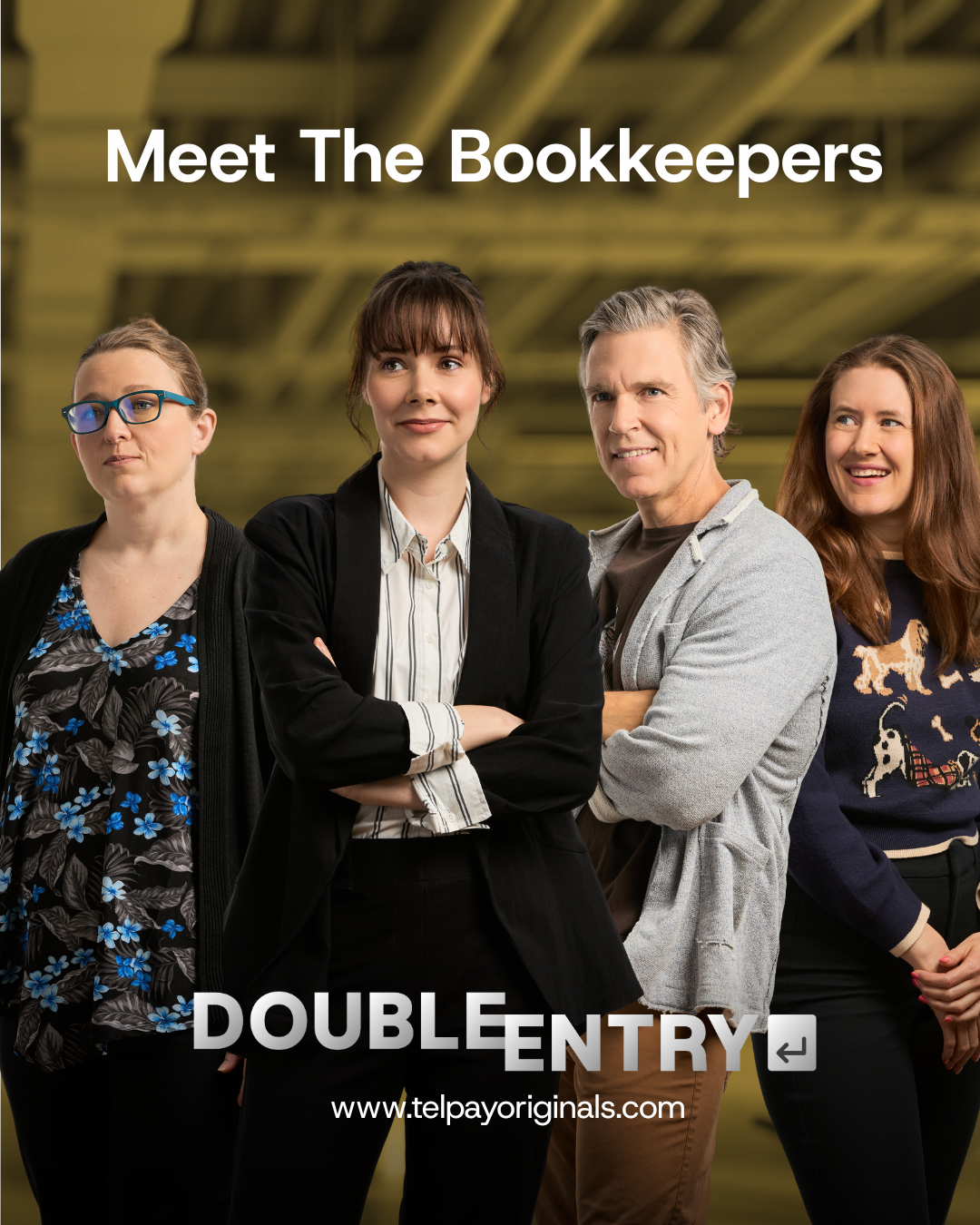
Double Entry began with a simple insight: bookkeepers and small business owners—our core audience—are overwhelmed, under-celebrated, and rarely portrayed accurately or empathetically in media. Traditional B2B marketing wasn’t breaking through to them. We needed a radically different approach: instead of advertising at them, we wanted to create something for them.
Our objective was to build a branded entertainment series that would deepen emotional connection with the bookkeeping community, elevate their lived experiences, and differentiate Telpay in an industry where products often feel interchangeable.
We wanted bookkeepers to love Telpay—even if they didn’t use our product today. Our ambition was to create something so thoughtful, so enjoyable, and so deeply reflective of their world that they would want Telpay to be a great product simply because they loved the stories we made for them.
Key goals included:
Affinity: Build trust and emotional connection with bookkeepers.
Visibility: Establish Telpay as the most human, story-driven brand in Canadian fintech.
Education-through-entertainment: Highlight the emotional and operational challenges of bookkeeping through relatable storytelling.
Community engagement: Spark conversation, shareability, and a sense of "finally, someone gets us."
Brand halo: Allow affinity to naturally create curiosity about Telpay-without ever mentioning the brand in the series.
Ultimately, the idea driving the project was bold: tell great stories first, build brand affinity second, and let the product world exist around the edges. If the audience saw themselves in the characters, the series would succeed.
To bring Double Entry to life, we treated it like a true scripted series—not a marketing campaign. Our strategy centered on authenticity, craft, and a deep respect for the bookkeeping profession.
1. Deep Audience Research
We conducted dozens of interviews with bookkeepers across Canada, gathering unfiltered stories of chaotic client handoffs, software frustrations, isolation, deadline pressure, and the unexpected humor woven throughout their work. These insights shaped every aspect of the series.
To extend each theme beyond entertainment, we developed downloadable resource kits that offer practical tools to help bookkeepers navigate the same issues portrayed in the show. The viewer journey became intentional: watch the show, laugh, and then download the kit.
2. Creative Development & World-Building
We built a fictional bookkeeping firm and cast an ensemble that reflects recognizable industry archetypes: the exhausted home-office bookkeeper, the zen eccentric, the overwhelmed junior, and the client who always messages “urgent!!!” at 11 p.m. The mockumentary format allowed us to lean into awkward silences, side-eye humor, and relatable office dynamics that feel pulled from real practice life.
3. Production Approach
We partnered with a professional film company and treated each episode like television: table reads, location scouting, cinematic lighting, character arcs, and multi-camera setups. Practicing bookkeepers reviewed scripts and terminology to ensure authenticity.
4. A New Kind of Brand Integration
Double Entry intentionally never mentions Telpay within its fictional world. Instead, the brand lives adjacent to the narrative—through distribution, companion content, and now through character-hosted product demos. By introducing familiar characters into bottom-of-funnel tutorials, we created a seamless bridge between emotional resonance and product value.
5. Distribution & Community Engagement
To reach bookkeepers at scale, we partnered with CPB Canada, the national professional association for bookkeepers. This partnership provided immediate credibility and access to a highly concentrated professional audience.
We distributed the series on YouTube and supported the rollout with coordinated promotion across Telpay’s social channels, targeted paid advertising, and outreach into the bookkeeping community. To encourage organic amplification, we ran social contests inviting bookkeepers to share the show.
To expand reach beyond our channels, we created press kits for industry media, influencers, content creators, and educational institutions—positioning Double Entry as both entertainment and a cultural contribution to the profession.
6. Challenges & How We Solved Them
7. The Use of AI
AI was used in two limited ways: to assist with early episode outlining and optional dialogue ideas, and to enhance one short parrot movement in a scene where live footage didn’t capture the needed action. All final scripts, performances, visuals, and creative decisions remain entirely human-driven.
Double Entry has only been in market for two months, yet the early results show remarkable traction within a highly niche audience. All six episodes—each approximately eight minutes—were released between October and late November. Despite the short timeframe, the series has already reached over 3,000 bookkeepers, representing a significant share of Canada’s bookkeeping community.
The response has been overwhelmingly positive. Viewers describe the series as authentic, relatable, and a refreshing reflection of their lived experience. Many bookkeepers have written to us saying they “felt seen,” “laughed out loud,” or immediately shared the show with colleagues.
The premiere at CPB Canada’s national conference further validated the impact: 400 bookkeepers watched the trailer together, laughing throughout, and our booth was flooded afterward. One bookkeeper signed up for Telpay on the spot after seeing just the trailer.
From a marketing perspective, Double Entry has quickly become a powerful top-of-funnel engine. The series and its companion resource kits have added hundreds of new leads to our database—specifically from our primary buyer audience. These leads are now moving through structured mid-funnel and bottom-funnel nurture campaigns.
While the series intentionally never mentions Telpay within its fictional world, we are now extending the characters into product tutorials and more conversion-oriented content. This creates a seamless bridge between entertainment and product value, deepening engagement as prospects move toward becoming customers.
Even at this early stage, Double Entry is proving to be both a cultural success and a commercial driver—and momentum continues to grow each week.