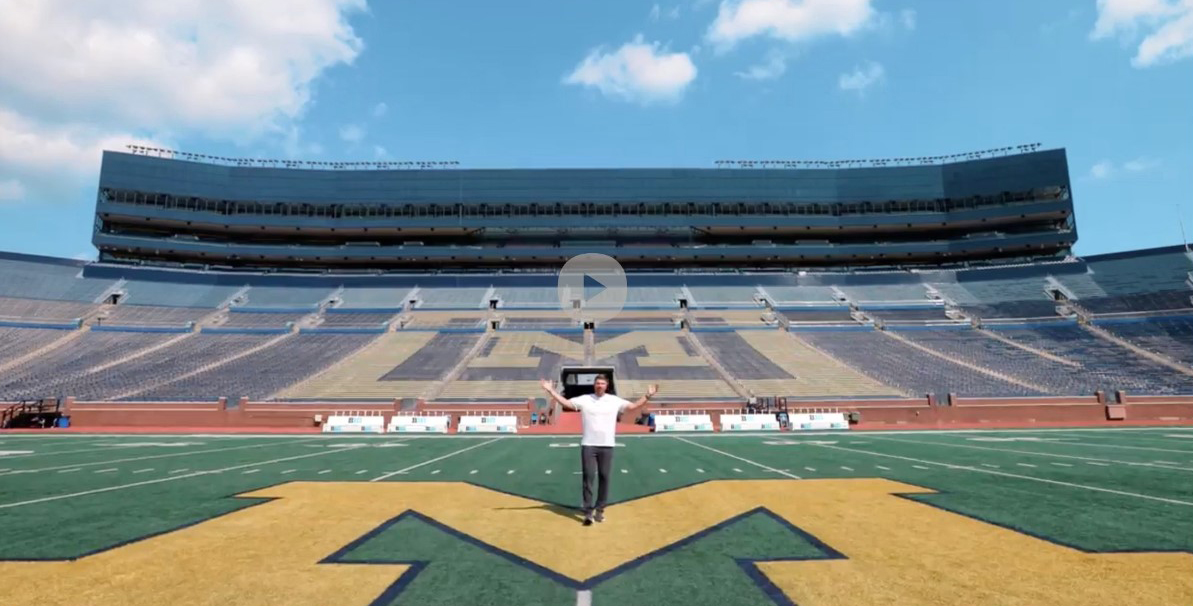
The objective of this project was to fundamentally modernize how critical safety information is delivered to law-enforcement and public-safety professionals working large-scale events at Michigan Stadium - one of the most complex event environments in the country.
For decades, pre-event briefings relied on lengthy, slide-based presentations that were time-intensive to produce, difficult to sustain attention through, and increasingly misaligned with the realities of an experienced, fast-moving workforce. The goal was not simply to shorten the briefing, but to improve clarity, retention, and readiness for officers responsible for protecting tens of thousands of attendees.
Specifically, the project aimed to:
By leveraging cinematic storytelling, clear visual context, and standardized messaging, the objective was to create a video format that improved comprehension, saved operational time, and enhanced public-safety readiness - proving that creative video production can directly support real-world safety outcomes.
The strategy centered on a guiding principle: if safety information is critical, it must be delivered in a way that commands attention, reinforces memory, and respects the realities of the audience receiving it.
The Division of Public Safety and Security (DPSS) team began by auditing the existing 72-slide briefing to identify core life-safety messages, operational requirements, and legal mandates that could not be lost. These elements became the foundation of a tightly structured script that prioritized clarity, sequencing, and actionability, transforming dense policy and logistics into a cohesive narrative that officers could see themselves in.
After the script was written and rewritten, the team pulled together a working group composed of key partners and stakeholders involved in the event briefings. This working group helped review and formalize the script and visual plan, ensuring a cross-functional, accurate representation of vital information.
To elevate engagement and credibility, the team selected Jon Jansen, a former University of Michigan football player and respected sports broadcaster, as the narrator. His voice brought instant authority, familiarity, and institutional trust, helping bridge the gap between law enforcement operations and Michigan Stadium's culture. The narration was intentionally concise, allowing visuals to carry context and reinforce understanding rather than duplicating on-screen text.
Cinematography, pacing, and editing played central roles in the execution of the video, led by Video Vision 360. The video combined sweeping stadium visuals, real-world operational footage, and both organic and staged environments to ground procedures in physical space and relay protocols effectively. Officers could visually orient themselves to posts, routes, and responsibilities - reducing cognitive load and improving situational awareness before deployment.
One of the primary challenges was balancing information density with engagement. The video needed to deliver complex, high-stakes content - ranging from access control and communications protocols to emergency response expectations - without overwhelming viewers or sacrificing attention. This was solved through disciplined scripting, a clear narrative arc, and beautiful imagery that mirrored how event staff experience an event.
Another challenge was scalability. The team designed a repeatable framework that could be efficiently updated and reused across events, eliminating the need to rebuild briefings from scratch. The video became the backbone of every large-scale event briefing for Michigan Stadium, supported by streamlined reference materials and supervisor checklists that reinforced key points without extending briefing time.
Ultimately, the project succeeded by applying broadcast-level storytelling and production discipline to an operational environment - proving that when information is delivered with intention, clarity, and craft, it can improve readiness, alignment, and safety outcomes at scale.
Measurable Impact & Results
The impact was immediate, measurable, and significant:
Why This Work Matters
At its core, this project demonstrates the power of video as a public-service tool — not for entertainment, but for preparedness, clarity, and safety.
By applying storytelling principles typically reserved for broadcast media to an operational environment, the team:
This work shows how creative video production can directly support public safety outcomes — helping professionals do their jobs better, faster, and with greater confidence.